
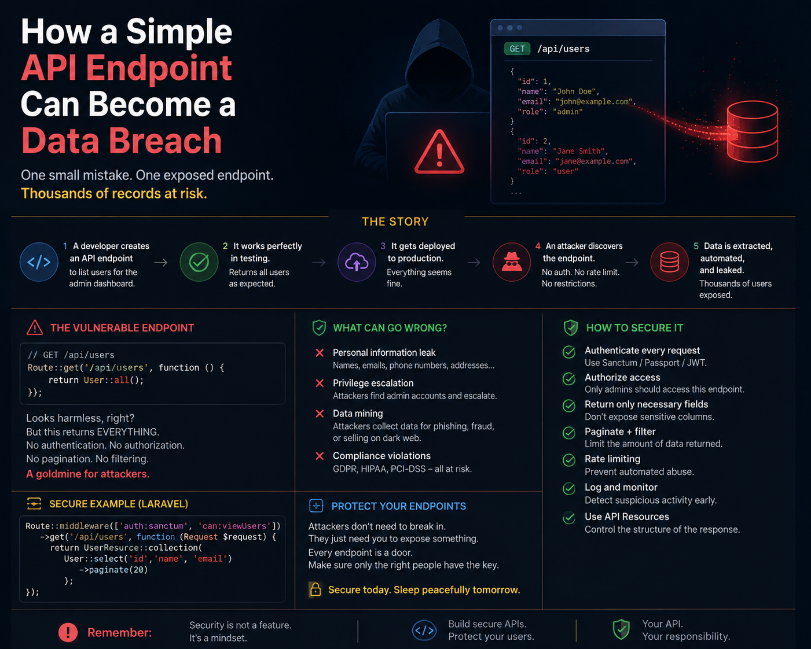
Most data breaches do not start with a dramatic hack. They start with a single API endpoint that nobody thought twice about.
A developer builds a quick endpoint to fetch a user’s profile. It works. It ships. Nobody revisits it for months. Then one day someone changes a number in the URL and pulls up a stranger’s data. No malware, no phishing email, no zero-day exploit. Just an API that trusted the request a little too much.
This is how a huge share of modern data breaches actually happen, and it is why API security has become one of the most searched and most misunderstood topics in application security today.
Why API Endpoints Are the New Attack Surface
APIs are the connective tissue of almost every modern application. Mobile apps, web dashboards, partner integrations, and internal microservices all talk to each other through API endpoints. Each endpoint is a door. Some doors are locked properly. Some are not.
Unlike a traditional website, an API does not always have a visible interface that hints at what is happening behind it. A single endpoint can expose far more data than the front-end ever shows, and attackers know this. They do not need to break the lock. They just need to find the door that was left ajar.
Search interest in terms like API security, broken authentication, and data breach through API has climbed steadily because security teams and developers alike are realizing this is not an edge case. It is a pattern.
The Anatomy of a Breach That Starts Small
Here is the typical chain of events, stripped of jargon:
1. An endpoint is built for convenience, not for security. A developer needs to pull order history for a logged-in user, so they build /api/orders/{id}. It works in testing. Nobody asks what happens if {id} belongs to someone else.
2. Authorization is checked at login, not at every request. The app confirms the person is logged in. It does not confirm they are allowed to see the specific record they are requesting. This gap has a name: Broken Object Level Authorization, or BOLA. It is consistently ranked among the most common API vulnerabilities found in real-world audits.
3. The endpoint returns more data than the screen displays. Even if the front-end only shows a name and order status, the raw API response might include a full address, phone number, or internal notes. This is called excessive data exposure, and it means the breach can happen even if the interface looks perfectly safe.
4. There is no rate limiting. Once someone finds that changing an ID number returns a different record, a simple script can loop through thousands of IDs in minutes. Without rate limiting or anomaly detection, this goes unnoticed until the data is already gone.
5. Error messages give away too much. A verbose error message meant to help developers debug can also help an attacker understand the database structure, the framework in use, or which requests almost succeeded.
None of these steps require advanced skill. That is exactly why this pattern shows up again and again in breach reports across industries, from healthcare portals to fintech apps to e-commerce platforms.
Real Patterns Security Teams Keep Finding
Security researchers and penetration testers repeatedly flag the same handful of issues:
- Predictable, sequential IDs in the URL path
- Missing checks that confirm a token or session actually owns the resource being requested
- Internal or admin endpoints that were never meant to be public but were never properly restricted either
- APIs that were documented internally, forgotten, and left running in production
- Third-party integrations that inherited more access than the task required
Each of these sounds minor on its own. Combined, they are how small oversights become headline-level data breaches.
Why This Keeps Happening
It is tempting to blame carelessness, but the real cause is usually speed. Teams are shipping features fast, APIs multiply quickly across an organization, and security review often happens after launch, if it happens at all. An endpoint that made sense for a two-person prototype often survives, unchanged, into a product used by millions.
There is also a visibility problem. Many organizations genuinely do not know how many API endpoints they have running. You cannot secure what you cannot see, and shadow APIs, meaning endpoints that exist outside official documentation, are a growing source of exposure.
How to Prevent an Endpoint From Becoming a Breach
Fixing this does not require a full rebuild. It requires discipline at a few key points.
Authenticate the user, then authorize the request. Every single time data is requested, the system should confirm that this specific user is allowed to see this specific record. Not just that they are logged in.
Return only what is needed. If the interface shows three fields, the API should not return thirty. Minimizing the response payload reduces what an attacker can gain even if they do get through.
Rate limit and monitor. Unusual request patterns, like the same account pulling thousands of different record IDs in a short window, should trigger an alert, not silence.
Audit endpoints regularly. Old, unused, or undocumented endpoints should be found and either secured or shut down. A quarterly API inventory catches problems before attackers do.
Keep error messages generic in production. Save the detailed debugging information for logs that only your team can see, not for the response sent back to the client.
Treat API security as an ongoing practice, not a launch checklist. New endpoints get added constantly. Each one needs the same scrutiny as the first one did.
The Bigger Picture
The uncomfortable truth is that most API-driven data breaches are not caused by sophisticated attackers outsmarting advanced defenses. They are caused by an endpoint that was reasonable when it was written and dangerous by the time anyone looked at it again.
Treating every API endpoint as a potential entry point, rather than a background utility, is the single biggest shift an engineering team can make. It costs far less to review an endpoint properly today than to explain a breach to customers tomorrow.
If your team is building or scaling an API-driven product, the right time to think about authorization, data exposure, and monitoring is before launch, not after an incident report lands on your desk.
