
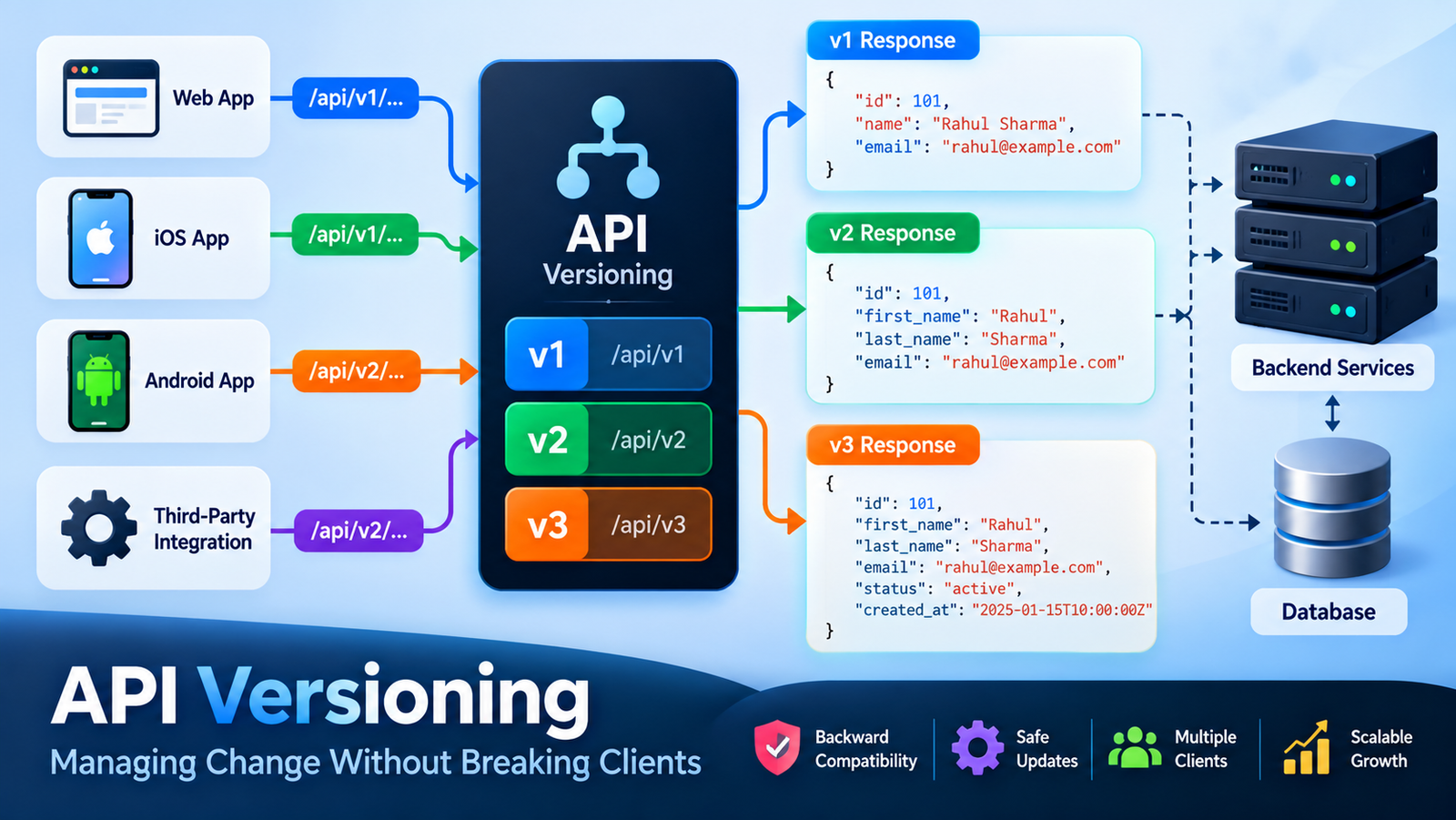
APIs play a critical role in modern application development. They allow frontend applications, mobile apps, backend services, and third-party platforms to communicate and exchange data.
However, applications evolve over time. Developers introduce new features, modify response structures, improve security, and update business logic. These changes can create problems when existing clients depend on the API’s current behavior.
Imagine updating an API response to rename a field. Your new frontend works perfectly, but an older mobile application suddenly stops displaying customer information.
The problem is not the new feature. It is the unexpected impact on existing clients.
API versioning helps developers introduce changes while maintaining compatibility with existing applications.
In this article, we will explore what API versioning is, why it matters, the most common versioning strategies, practical implementation examples, and best practices for managing API changes safely.
What Is API Versioning?
API versioning is the practice of maintaining different versions of an API so that developers can introduce changes without immediately breaking applications that depend on earlier versions.
Each version defines a particular contract between the API provider and its clients. This contract includes endpoints, request parameters, response structures, and expected behavior.
For example:
GET /api/v1/users
GET /api/v2/users
Version 1 might return a user’s full name in a single field, while Version 2 separates it into first and last names.
{
  "id": 101,
  "name": "Rahul Sharma"
}
A newer version might return:
{
  "id": 101,
  "first_name": "Rahul",
  "last_name": "Sharma"
}
If the original response changes without warning, clients expecting the name field may fail.
By maintaining separate API versions, developers can introduce the new structure while giving existing clients time to migrate.
The main goal of API versioning is to manage change without disrupting existing integrations.
Why Is API Versioning Important?
API versioning becomes increasingly important as an application grows and serves multiple clients.
A single backend might support a website, an Android application, an iOS application, and several third-party integrations. These clients may not all update at the same time.
Without a clear versioning strategy, even a small API change can create widespread problems.
1. Maintain Backward Compatibility
Backward compatibility means that existing clients can continue working when the API evolves, provided the changes preserve the behavior they depend on.
For example, adding an optional response field is generally less disruptive than removing an existing field.
Versioning allows developers to introduce incompatible changes without forcing every client to migrate immediately.
2. Support Multiple Applications
Different applications may depend on different API contracts.
For example:
- A legacy mobile application may use API v1.
- A newer mobile application may use API v2.
- A website may continue using API v1 while its migration is being developed.
Maintaining versions allows these clients to coexist during a planned transition.
3. Introduce New Features Safely
New API versions can support improved response structures, additional functionality, and changes to business logic.
Developers can introduce these improvements without immediately changing the behavior expected by older clients.
4. Reduce Integration Failures
Unexpected API changes can cause failed requests, incorrect data displays, and application errors.
A documented versioning strategy makes changes more predictable and reduces the risk of disrupting integrations.
5. Simplify API Maintenance
Versioning gives development teams a structured approach to introducing breaking changes, communicating updates, and eventually retiring older versions.
It also encourages teams to document compatibility requirements before releasing changes.
What Are Breaking and Non-Breaking API Changes?
Before choosing a versioning strategy, it is important to understand which changes require a new version.
A breaking change is a change that can cause an existing client to stop working correctly.
A non-breaking change preserves the behavior existing clients rely on.
| API Change | Typical Classification |
|---|---|
| Adding an optional response field | Non-breaking |
| Adding a new endpoint | Non-breaking |
| Removing an existing response field | Breaking |
| Renaming a response field | Breaking |
| Changing a field’s data type | Breaking |
| Making an optional request parameter mandatory | Breaking |
| Changing an endpoint’s behavior unexpectedly | Potentially breaking |
| Removing an existing endpoint | Breaking |
These classifications depend on the API contract and client behavior. For example, adding an enum value may break a client that assumes only a fixed set of values is possible.
Not every API change requires a new version. Compatible improvements can often be introduced within an existing version, while incompatible changes need a deliberate migration strategy.
Common API Versioning Strategies
There are several ways to identify API versions. The right choice depends on the application’s architecture, client requirements, and API governance practices.
1. URL Path Versioning
URL path versioning places the version directly in the endpoint.
For example:
GET /api/v1/products
GET /api/v2/products
Each version can expose its own API contract.
Advantages:
- Easy to understand.
- Simple to test in a browser or API client.
- Easy to document.
- Straightforward to route to different implementations.
Disadvantages:
- Can create duplicate routes or controllers.
- Requires a clear strategy for maintaining multiple versions.
- Clients must change their URLs when migrating.
URL path versioning is a practical choice for many REST APIs because the version is immediately visible.
2. Header Versioning
Header versioning identifies the API version through an HTTP request header.
For example:
GET /api/products
API-Version: 2
The server reads the header and returns the response associated with the requested version.
A different approach uses content negotiation:
Accept: application/vnd.example.v2+jsonThe server uses the Accept header to identify the requested representation.
Advantages:
- Keeps the endpoint URL stable.
- Allows version information to be separated from the resource path.
- Can support different representations of the same resource.
Disadvantages:
- Less visible when inspecting a URL.
- Requires clients to send the correct header.
- Can make caching and troubleshooting more complicated if responses vary by version.
Header versioning can be useful when an API platform has an established convention for request headers and content negotiation.
3. Query Parameter Versioning
This strategy passes the version as a query parameter.
For example:
GET /api/products?version=2The server uses the parameter to determine which API contract to apply.
Advantages:
- Simple to implement.
- Easy to inspect in API requests.
- Does not require separate versioned paths.
Disadvantages:
- Can complicate caching rules.
- Makes it easier for clients to omit the version accidentally.
- Requires consistent handling across endpoints.
Query parameter versioning can work, but it is important to document the convention and ensure that version parameters are handled consistently.
Which API Versioning Strategy Should You Choose?
| Strategy | Best Suited For | Main Consideration |
|---|---|---|
| URL path | Public APIs and straightforward REST services | Versions are visible in endpoint paths |
| Header | APIs with established header conventions | Version selection is less visible |
| Query parameter | Simple integrations and controlled environments | Parameter handling must be consistent |
For many web applications, URL path versioning is a reasonable starting point because it is explicit and easy to understand.
However, consistency matters more than choosing a particular strategy. Once a versioning approach is established, apply it consistently across the API.
How to Implement API Versioning
Let’s consider a practical example involving a customer API.
Suppose the original endpoint returns:
GET /api/v1/customers/101Its response is:
{
  "id": 101,
  "name": "Rahul Sharma",
  "email": "rahul@example.com"
}
The development team now wants to separate the customer’s first and last names.
Changing the original response could break applications that depend on the name field.
Instead, introduce a new version.
Step 1: Define the New API Contract
Version 2 returns:
GET /api/v2/customers/101{
"id": 101,
"first_name": "Rahul",
"last_name": "Sharma",
"email": "rahul@example.com"
}The new version provides a different response structure while the original version remains available.
Step 2: Separate Version-Specific Behavior
In a well-structured application, controllers or response transformers can handle differences between versions.
For example:
API
 |
 +-- v1
 |    |
 |    +-- CustomerController
 |    +-- CustomerResource
 |
 +-- v2
      |
      +-- CustomerController
      +-- CustomerResource
This is a conceptual structure, not a mandatory directory layout.
The underlying business logic does not necessarily need to be duplicated. Both versions can share the same service layer and database access while returning different response structures.
Step 3: Test Both Versions
Before releasing Version 2, verify that:
- Version 1 returns its expected response.
- Version 2 returns the new response structure.
- Authentication and authorization work correctly.
- Validation rules behave as documented.
- Error responses are consistent.
- Existing integrations continue to work.
Automated contract tests can help detect accidental changes to established API behavior.
Step 4: Document the Changes
Documentation should explain what changed, which clients should migrate, and whether any existing fields or endpoints will eventually be removed.
Clear documentation reduces confusion for internal teams and external developers.
API Versioning Best Practices
Creating a new version is only one part of managing API changes. Teams also need a strategy for compatibility, testing, documentation, and retirement.
1. Introduce New Versions Only When Necessary
Not every feature requires a new API version.
Adding an optional field or introducing a separate endpoint may be possible without breaking existing clients.
Reserve new versions primarily for changes that cannot safely preserve the existing contract.
2. Keep Versioning Consistent
Choose a versioning strategy and apply it consistently.
Avoid mixing URL paths, headers, and query parameters without a clear architectural reason.
Consistency makes APIs easier to understand, test, and maintain.
3. Maintain Clear API Documentation
Document endpoints, request parameters, response fields, error formats, authentication requirements, and version-specific behavior.
Tools such as OpenAPI can help teams describe API contracts and generate documentation.
4. Use Automated Contract Testing
Contract tests verify that an API continues to meet the expectations defined for a particular version.
They can help detect accidental changes to response structures, required parameters, and error behavior.
Run these tests as part of the development and deployment process.
5. Monitor API Usage
Track which clients use each version, how frequently endpoints are called, and whether requests are failing.
Usage data helps identify clients that still depend on an older version.
Avoid collecting unnecessary personal information in API logs.
6. Communicate Breaking Changes Early
Notify developers before introducing breaking changes.
Explain what will change, why the change is necessary, which clients are affected, and how to migrate.
Where appropriate, provide migration guides and a clear support timeline.
7. Plan API Deprecation Carefully
Older versions eventually become expensive to maintain.
However, removing them without understanding client dependencies can disrupt production applications.
Before retiring a version:
- Announce the deprecation.
- Publish a migration guide.
- Identify clients that still use the old version.
- Provide a reasonable migration period.
- Monitor adoption of the replacement version.
- Communicate the retirement date.
- Remove the old version according to the published plan.
Deprecation and removal are separate steps. Marking a version as deprecated communicates that it should no longer be used for new development, while allowing existing clients time to migrate.
Common API Versioning Mistakes
Even well-designed APIs can become difficult to maintain when versioning is handled inconsistently.
Avoid these common mistakes:
- Changing existing response fields without warning: This can break clients that depend on those fields.
- Creating a new version for every minor improvement: Excessive versioning increases maintenance overhead.
- Maintaining versions without usage monitoring: Unused versions can remain active longer than necessary.
- Duplicating all business logic: Version-specific responses do not always require duplicated service logic.
- Ignoring documentation: Developers may not understand which version they should use.
- Removing old versions too quickly: Some clients may not be able to migrate immediately.
- Assuming every additive change is safe: Even adding a field or enum value can affect clients with strict assumptions.
A good versioning strategy balances innovation with compatibility.
Frequently Asked Questions
What is API versioning?
API versioning is a method of managing changes to an API while allowing different clients to use compatible versions of its contract.
Why is API versioning important?
It helps prevent breaking changes from disrupting existing applications and integrations. It also allows development teams to introduce improvements through a controlled migration process.
Which API versioning strategy is best?
URL path versioning is often a practical starting point because it is explicit and easy to test. Header and query parameter versioning can also work when they fit the API’s requirements.
Does every API change require a new version?
No. Compatible changes can often be introduced within an existing version. A new version is generally appropriate when a change would break the existing API contract.
How do you maintain backward compatibility?
Preserve existing behavior, avoid removing or renaming fields unexpectedly, test API contracts, document changes, and introduce new versions when incompatible changes are necessary.
When should an old API version be retired?
Retire an old version when its replacement is available, affected clients have had a reasonable opportunity to migrate, and usage monitoring indicates that the retirement plan is ready. The exact timeline depends on the service’s support commitments and client requirements.
Conclusion
API versioning is essential for applications that evolve while supporting multiple clients and integrations.
Without a clear strategy, changes to response fields, endpoints, or business behavior can break existing applications and create unnecessary maintenance work.
By choosing a consistent versioning approach, maintaining backward compatibility, testing API contracts, documenting changes, and planning deprecation carefully, development teams can introduce improvements without unnecessarily disrupting existing clients.
The goal of API versioning is not to create more versions. It is to manage change in a predictable, controlled, and reliable way.
When API changes are planned carefully, developers can improve their services while giving clients the stability they need.
