
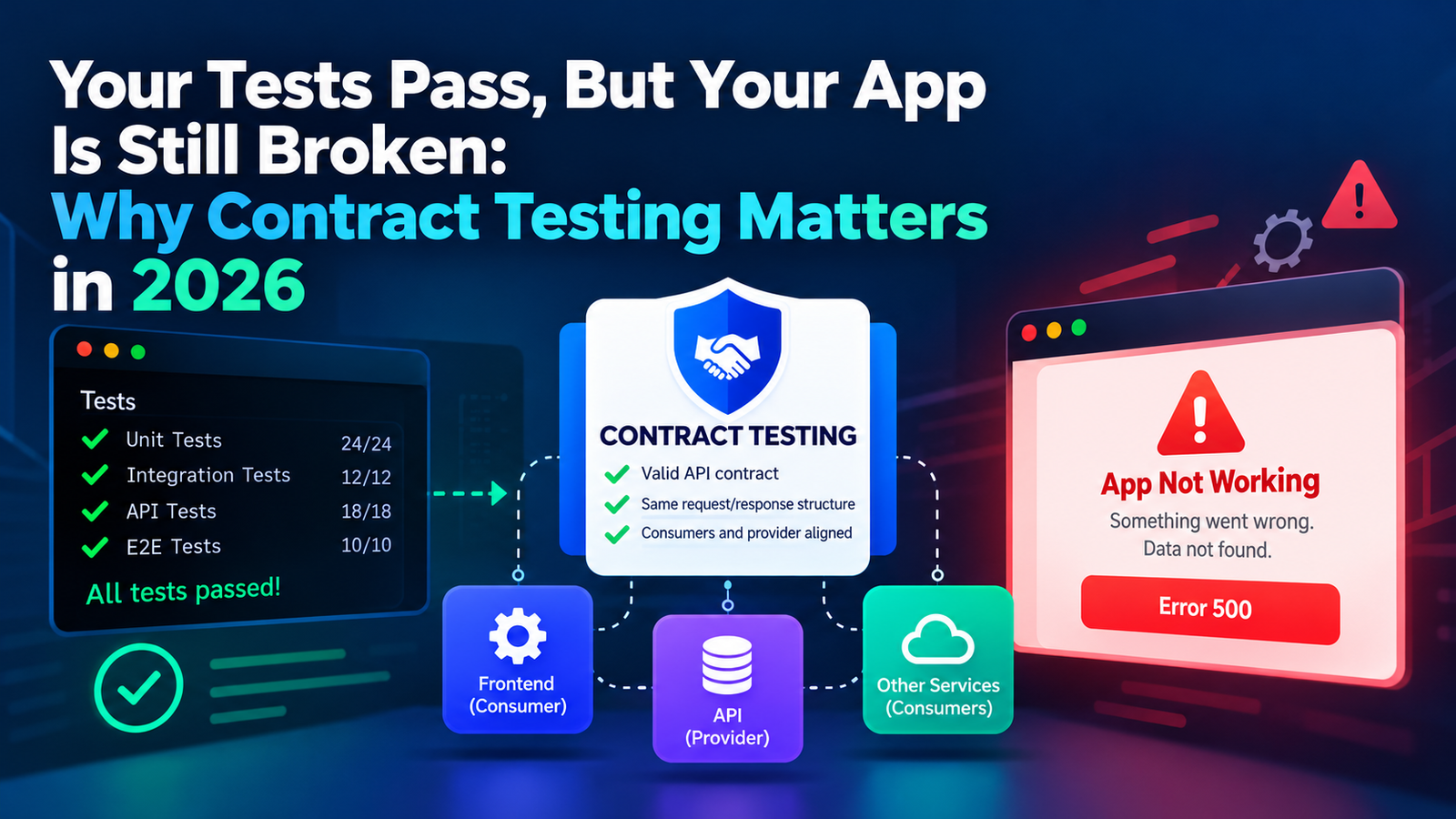
A frontend developer runs the tests. Everything passes.
The backend developer runs the API tests. Those pass too.
The CI pipeline is green, but the application crashes after deployment. Why? The backend has changed an API response, and the frontend can no longer find the data it expects.
This is a common problem in full-stack development. Individual components may work correctly but fail when they communicate with each other.
Contract testing helps prevent these issues by checking whether applications and APIs follow the same communication rules.
What Is Contract Testing?
Contract testing verifies whether two software components follow an agreed set of rules when communicating.
For APIs, these rules define endpoints, request parameters, response structures, data types, and status codes.
For example, a frontend might request user information using:
GET /api/users/123
The expected response is:
{
  "id": 123,
  "name": "John",
  "email": "john@example.com"
}
The frontend depends on these fields to display user information.
If the backend renames name to full_name, the frontend might stop displaying the user’s name correctly.
Contract testing identifies such compatibility problems before they reach production.
Why Is Traditional Testing Not Enough?
Different testing methods serve different purposes.
- Unit testing: Checks individual functions and components.
- Integration testing: Checks whether connected components work together.
- End-to-end testing: Checks complete user workflows.
- Contract testing: Checks whether applications and APIs communicate as expected.
For example, backend unit tests may pass even when the backend changes a response field that the frontend requires.
Contract testing focuses on this communication gap.
Combining these testing methods helps developers identify different types of problems.
Consumer and Provider in Contract Testing
Contract testing involves two main components.
Consumer: The application that requests data from an API. Examples include React applications, Vue applications, and mobile apps.
Provider: The application that supplies the API. Examples include Laravel, Node.js, and Spring Boot applications.
The consumer defines what it expects, while the provider verifies whether it can satisfy those expectations.
This approach is particularly useful when frontend and backend teams develop their applications independently.
What Is Consumer-Driven Contract Testing?
Consumer-driven contract testing allows the consumer to define the API behavior it depends on.
For example, a frontend may expect a user endpoint to return id, name, and email.
These expectations become part of the contract. The backend team then checks whether its implementation satisfies them.
Consider a company with a website, admin dashboard, and mobile application using the same API.
If the backend renames a response field, one or more applications might break. Consumer-driven contract testing helps identify the affected applications before deployment.
Using Pact and OpenAPI
Pact
Pact is a popular tool for consumer-driven contract testing.
A typical workflow involves:
- Writing consumer tests.
- Generating a contract.
- Sharing the contract with the provider.
- Verifying the provider against the contract.
- Fixing incompatible changes before deployment.
Pact helps teams identify API compatibility problems when different services are developed and released independently.
OpenAPI
OpenAPI describes HTTP APIs, including endpoints, parameters, request bodies, response structures, and authentication requirements.
Teams can use OpenAPI specifications for documentation, validation, client generation, and automated testing.
OpenAPI and contract testing complement each other. The specification describes the API, while automated verification checks whether implementations meet the relevant expectations.
Contract Testing vs. End-to-End Testing
Contract testing and end-to-end testing solve different problems.
End-to-end testing checks whether a complete user journey works, such as logging in, selecting a product, and completing checkout.
Contract testing checks whether an API returns the information that its consumer expects.
E2E tests can identify problems with navigation, page rendering, and user interactions. Contract tests focus on compatibility between systems.
Contract tests can also validate API compatibility without running the entire workflow through a browser.
Therefore, both approaches are important for a reliable full-stack application.
Breaking API Changes to Watch For
API changes can break applications when they affect existing consumer expectations.
Common examples include:
- Renaming or removing response fields.
- Changing data types.
- Making required fields nullable.
- Changing HTTP status codes.
- Modifying authentication requirements.
- Changing request parameters.
For example, changing an email field from a guaranteed string to a value that can also be null may cause problems if the frontend assumes the email always exists.
Contract testing helps identify these changes before they affect users.
Whenever possible, developers should prefer backward-compatible API changes.
Contract Testing in CI/CD
Contract testing becomes more useful when integrated into a CI/CD pipeline.
A pipeline might run unit tests, integration tests, contract verification, and selected end-to-end tests before deployment.
Suppose a backend developer removes a field required by the frontend.
Automated contract verification can detect the incompatibility during the development process. The team can fix the problem before merging or deploying the change.
This reduces the risk of discovering API compatibility issues in production.
Contract Testing in Microservices and Monolithic Applications
Contract testing is useful for both microservices and monolithic applications.
In a microservices architecture, services such as users, orders, payments, and inventory communicate through APIs. Each connection can introduce compatibility problems.
Contract testing helps verify that these services continue to meet their consumers’ expectations.
A monolithic application can benefit too. For example, a frontend communicating with a Laravel API still depends on a defined interface.
Contract testing focuses on communication boundaries, not deployment architecture.
Contract Testing for Mobile and GraphQL Applications
Mobile applications may continue using older API versions while the backend changes. Contract testing helps teams check whether API updates remain compatible with supported mobile clients.
The same principles apply to GraphQL APIs.
A GraphQL schema defines the fields clients can request. Removing a field or changing its nullability can affect applications that depend on it.
Schema compatibility checks and contract testing practices help developers identify these risks before release.
Common Contract Testing Mistakes
Avoid these common mistakes when implementing contract testing:
1. Testing implementation details: Focus on what consumers need rather than internal code or database structures.
2. Making contracts too strict: Include important expectations without creating unnecessary failures for harmless changes.
3. Ignoring error responses: Test relevant validation, authentication, and authorization responses.
4. Running tests only locally: Integrate contract verification into CI/CD for consistent checks.
5. Treating contracts as documentation only: Use automated verification to detect incompatibilities.
A Practical Contract Testing Workflow
Follow these steps to introduce contract testing into a full-stack project:
- Define the API: Specify the endpoint, request, and expected response.
- Create the contract: Define required fields, data types, and status codes.
- Write consumer tests: Describe the API interactions the application needs.
- Verify the provider: Check whether the backend satisfies the contract.
- Automate verification: Run contract tests through CI/CD.
- Fix failures early: Resolve incompatible changes before deployment.
This workflow helps teams identify problems while they are still relatively easy to fix.
How Playwright Complements Contract Testing
Playwright and contract testing address different testing requirements.
Playwright checks browser behavior, navigation, forms, authentication, and user workflows.
Contract testing checks API compatibility, response structures, required fields, and status codes.
For example, a contract test can verify that a product API returns the expected information. A Playwright test can check whether the product page displays that information correctly.
Using both provides broader application coverage.
Why Contract Testing Matters in 2026
Modern applications often depend on multiple APIs, mobile apps, internal services, and third-party integrations.
As these connections grow, manually tracking every dependency becomes more difficult.
Contract testing makes API expectations explicit and helps teams identify breaking changes early.
It also improves collaboration between frontend developers, backend developers, QA engineers, and DevOps teams.
The goal is not to prevent APIs from changing. Instead, teams should make changes intentionally and check their impact before deployment.
Final Thoughts
Passing tests does not always mean an application will work correctly when its components communicate.
Frontend and backend tests may pass independently while an API change breaks their connection.
Contract testing helps prevent this problem by checking whether API providers and consumers follow the same expectations.
Combined with unit, integration, API, and end-to-end testing, it helps developers detect problems earlier and build more reliable applications.
The key lesson is simple: test whether your code works, but also test whether your systems still work together.
