
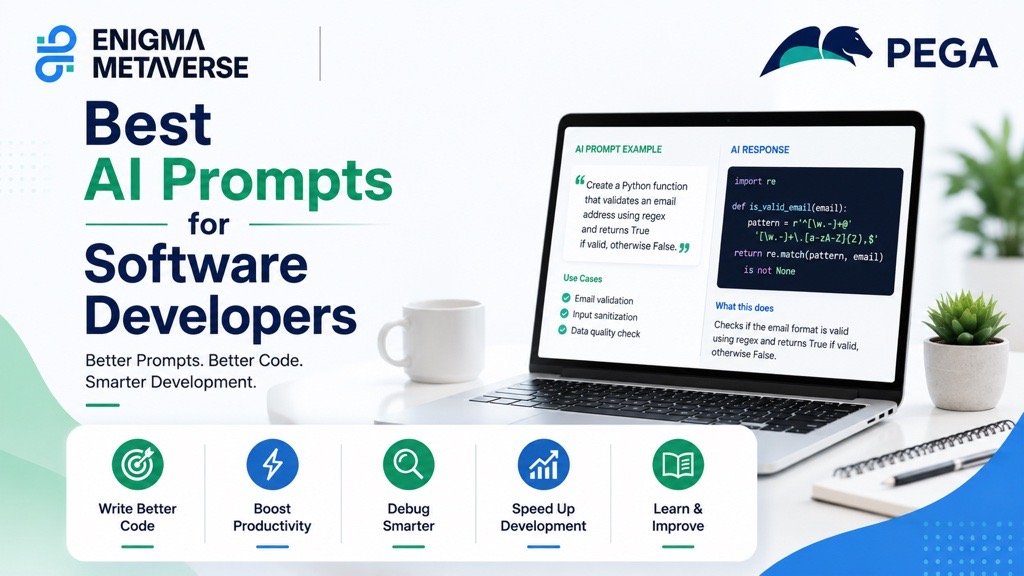
Artificial Intelligence (AI) has rapidly become an essential part of modern software development. From writing code and debugging applications to generating documentation and reviewing pull requests, AI-powered tools are helping developers work more efficiently than ever before. However, the quality of the output generated by AI largely depends on the quality of the prompts provided. This is why understanding how to create effective prompts is becoming an important skill for software developers.
What Is an AI Prompt?
An AI prompt is the instruction or question given to an AI system to generate a response. It acts as a guide that tells the AI what task needs to be performed and what type of result is expected. A well-structured prompt provides enough context and details to help the AI deliver accurate and relevant responses.
For example, instead of asking an AI tool to “write code,” a developer can provide details about the programming language, functionality, requirements, and coding standards. The more specific the prompt, the more useful the output will be.
Why Effective Prompts Matter
AI tools are capable of processing vast amounts of information and generating solutions quickly. However, they do not automatically understand the exact requirements of a project. Poorly written prompts can lead to incomplete, inaccurate, or generic responses. Effective prompts help developers:
- Generate higher-quality code.
- Reduce debugging time.
- Improve software documentation.
- Enhance code reviews.
- Learn new technologies more efficiently.
- Increase overall productivity.
As AI becomes more integrated into development workflows, prompt engineering is emerging as a valuable skill for developers of all experience levels.
Common Types of AI Prompts for Developers
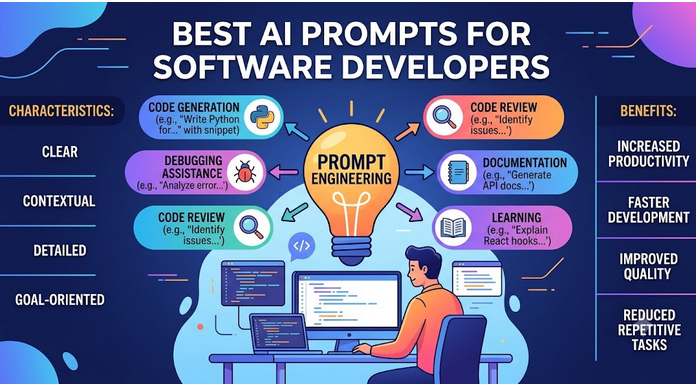
Code Generation Prompts
One of the most common uses of AI in software development is generating code. Developers can describe a feature, algorithm, or functionality and receive code suggestions in return. Effective code generation prompts typically include the programming language, framework, expected behavior, and any specific requirements.
Debugging Prompts
Debugging can be time-consuming, especially when dealing with unfamiliar errors. AI can assist by analyzing error messages and suggesting possible causes and solutions. Providing the complete error message, relevant code snippets, and application context helps the AI generate more accurate recommendations.
Code Review Prompts
AI can act as a virtual code reviewer by identifying potential bugs, security vulnerabilities, performance issues, and maintainability concerns. Developers can use prompts to request feedback on coding practices, architecture decisions, and optimization opportunities.
Documentation Prompts
Maintaining documentation is often overlooked in software projects. AI can help generate API documentation, technical specifications, user guides, and code explanations. Well-defined prompts ensure that the generated documentation is clear, consistent, and useful for both developers and stakeholders.
Learning and Research Prompts
Developers frequently need to learn new technologies, frameworks, and programming concepts. AI can simplify the learning process by providing explanations, tutorials, examples, and best practices tailored to the developer’s experience level.
Characteristics of a Good AI Prompt
To maximize the effectiveness of AI tools, developers should focus on creating prompts that are:
Clear
The prompt should clearly describe the task and avoid ambiguity. AI performs best when instructions are straightforward and specific.
Contextual
Providing context about the project, technology stack, and business requirements helps the AI generate more relevant responses.
Detailed
Including constraints, expected outputs, and technical requirements improves the quality of the generated results.
Goal-Oriented
A good prompt defines the desired outcome. Whether the goal is code generation, debugging, or documentation, the expected result should be clearly stated.
Benefits of Using AI Prompts in Development
The adoption of AI-powered tools offers several advantages for software developers:
- Faster development cycles.
- Improved code quality.
- Reduced repetitive tasks.
- Enhanced problem-solving capabilities.
- Better documentation and knowledge sharing.
- Increased productivity and efficiency.
By automating routine activities, developers can focus more on design, architecture, and solving complex business problems.
Conclusion
AI is transforming the way software is developed, tested, and maintained. While AI tools are powerful, their effectiveness depends heavily on the quality of the prompts provided. Developers who learn how to create clear, detailed, and context-rich prompts can unlock significant productivity gains and improve the quality of their work.
As AI continues to evolve, prompt engineering will become an increasingly valuable skill for software developers. Understanding how to communicate effectively with AI systems is no longer just an advantage—it is becoming an essential part of modern software development.
