
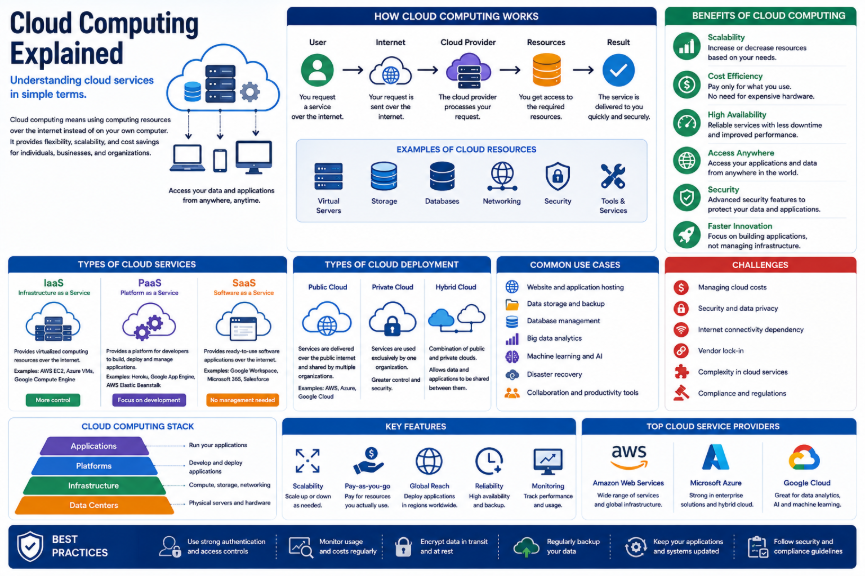
Cloud computing has become an essential part of modern technology. People use cloud-based services every day when they store photos online, stream videos, use email, access online applications, or save documents without keeping everything directly on their computers. Businesses also rely on cloud computing to host websites, store data, run applications, and provide services to customers around the world.
In simple terms, cloud computing means using computing resources such as servers, storage, databases, networking, and software over the internet instead of depending entirely on physical computers or servers located at a user’s workplace. Cloud providers manage much of the underlying infrastructure, allowing individuals and organizations to access the resources they need when they need them.
Cloud computing has changed the way applications and digital services are developed and delivered. Instead of purchasing expensive hardware and maintaining physical data centers, organizations can rent computing resources from cloud providers and scale them according to their requirements. This flexibility has made cloud computing an important foundation for modern software development, full stack applications, artificial intelligence, data processing, and online services.
Understanding Cloud Computing
Cloud computing is a technology model that provides computing resources through the internet. These resources can include virtual servers, storage, databases, networking, application platforms, security services, and development tools.
For example, instead of purchasing a physical server to host a website, a company can use a cloud server and pay for the resources it consumes. The cloud provider manages the physical infrastructure while the organization focuses on its application and business requirements.
This approach makes computing resources easier to access and allows businesses to increase or decrease resources based on demand.
How Cloud Computing Works
Cloud computing works by using large networks of physical servers located in data centers. Cloud providers combine these physical resources and make them available to customers through virtualized services and internet-based interfaces.
When a user requests a cloud service, the provider allocates the required computing resources and makes them available through the internet. Depending on the service, users may be able to create servers, databases, storage systems, or complete application environments within minutes.
This process allows organizations to access powerful infrastructure without having to physically manage the underlying hardware.
Types of Cloud Services
Cloud computing services are commonly divided into three major categories: Infrastructure as a Service (IaaS), Platform as a Service (PaaS), and Software as a Service (SaaS).
Infrastructure as a Service (IaaS) provides fundamental computing resources such as virtual machines, storage, and networking. It gives developers and organizations greater control over their infrastructure.
Platform as a Service (PaaS) provides an environment for developers to build, deploy, and manage applications without managing much of the underlying infrastructure.
Software as a Service (SaaS) provides complete software applications through the internet. Users can access these applications through a browser or application without installing and maintaining the underlying software infrastructure themselves.
These service models allow organizations to choose the level of control and management that matches their requirements.
Types of Cloud Deployment
Cloud environments can also be categorized according to how infrastructure is deployed.
A public cloud provides computing resources to multiple customers through a cloud provider’s shared infrastructure. It is commonly used because organizations can access resources without building their own data centers.
A private cloud is dedicated to a particular organization and provides greater control over infrastructure and configuration.
A hybrid cloud combines public and private cloud environments. Organizations can keep certain workloads in private infrastructure while using public cloud resources for other applications or workloads.
The appropriate deployment model depends on factors such as security, cost, performance, compliance, and business requirements.
Flexible Resource Usage
One of the biggest advantages of cloud computing is the ability to use resources according to demand. Traditional infrastructure often requires organizations to purchase enough hardware to handle expected future growth.
Cloud computing provides greater flexibility. Organizations can increase computing resources when demand rises and reduce them when demand decreases.
For example, an e-commerce application may require significantly more resources during a major sale than during normal periods. Cloud infrastructure can be adjusted to accommodate these changes without requiring the organization to purchase permanent hardware.
Cost Efficiency
Cloud computing can reduce the need for large upfront investments in physical infrastructure. Instead of purchasing servers, storage systems, networking equipment, and data center facilities, organizations can use cloud resources according to their requirements.
Many cloud services follow usage-based or subscription-based pricing models. This allows businesses to align infrastructure costs more closely with actual usage.
However, effective cost management remains important because poorly configured or unused cloud resources can result in unnecessary expenses.
Faster Application Development
Cloud platforms provide developers with ready-to-use infrastructure, databases, development tools, monitoring systems, and deployment services.
Instead of spending significant time configuring physical servers, developers can create environments quickly and begin building applications.
This accelerates development cycles and allows teams to release features and applications faster. Cloud services also make it easier to create separate development, testing, and production environments.
Improved Availability and Reliability
Cloud providers typically operate large infrastructure environments designed to support high availability. Applications can be distributed across multiple servers or locations to reduce the impact of individual hardware failures.
Organizations can also implement backup systems, redundancy, monitoring, and disaster recovery strategies using cloud services.
While cloud computing does not automatically guarantee that an application will never experience downtime, properly designed cloud architectures can significantly improve reliability.
Cloud Computing in Full Stack Development
Cloud computing plays an important role in modern full stack development. A complete web application can use cloud services for hosting the frontend, running backend APIs, storing database information, managing files, and monitoring application performance.
For example, a full stack application may have a frontend hosted through a cloud platform, a backend running on cloud servers, a managed database storing application data, and cloud storage for uploaded files.
This allows development teams to build and deploy complete applications without managing traditional physical infrastructure.
Security in Cloud Computing
Security is an important consideration when using cloud services. Cloud providers typically offer security features such as identity management, encryption, firewalls, access controls, monitoring, and security policies.
However, organizations are still responsible for properly configuring their cloud resources and protecting their applications and data.
Strong passwords, multi-factor authentication, appropriate permissions, encryption, regular monitoring, and secure application development practices are important for maintaining cloud security.
Common Uses of Cloud Computing
Cloud computing is used across many industries and applications.
Some common examples include:
- Website and application hosting.
- Online file storage and backup.
- Database hosting.
- Video and media streaming.
- Software development and testing.
- Data analytics.
- Artificial intelligence and machine learning.
- Business applications.
- Disaster recovery.
- Online collaboration tools.
These use cases demonstrate how cloud computing has become a fundamental part of modern digital infrastructure.
Challenges of Cloud Computing
Although cloud computing provides many benefits, organizations also need to manage several challenges.
Some common challenges include:
- Managing cloud costs effectively.
- Protecting sensitive information.
- Understanding complex cloud architectures.
- Avoiding unnecessary resource usage.
- Managing access permissions.
- Depending on internet connectivity.
- Avoiding excessive dependence on a single provider.
- Ensuring compliance with applicable regulations.
Proper planning, monitoring, security practices, and cost management can help organizations overcome these challenges.
Best Practices for Using Cloud Services
Organizations should follow good practices when adopting cloud computing to ensure that their environments remain secure, efficient, and cost-effective.
Some recommended practices include:
- Use strong authentication and multi-factor authentication.
- Give users only the permissions they actually need.
- Encrypt sensitive data.
- Monitor applications and infrastructure regularly.
- Remove unused cloud resources.
- Create regular backups.
- Monitor and control cloud spending.
- Design applications for scalability and reliability.
- Keep software and dependencies updated.
- Create a disaster recovery strategy.
Following these practices helps organizations make better use of cloud technologies while reducing operational and security risks.
The Future of Cloud Computing
Cloud computing continues to evolve as organizations adopt new technologies and digital services. Cloud platforms are increasingly being used alongside artificial intelligence, machine learning, Internet of Things devices, data analytics, and serverless computing.
Modern applications are also becoming more distributed, allowing businesses to process data and deliver services closer to users. Cloud computing provides the infrastructure required to support these technologies and enables organizations to experiment with new ideas without making large investments in physical infrastructure.
As digital transformation continues, cloud computing is expected to remain an important part of software development and business technology.
Conclusion
Cloud computing has transformed the way individuals and organizations use technology. By providing computing resources such as servers, storage, databases, networking, and software through the internet, cloud services make technology more flexible, scalable, and accessible.
The major advantages of cloud computing include flexible resource usage, faster development, reduced infrastructure requirements, improved availability, and access to a wide range of technology services. At the same time, organizations must carefully manage security, costs, permissions, and application architecture to use cloud services effectively.
Understanding cloud computing does not require knowing every technical detail of cloud infrastructure. At its core, the concept is simple: instead of owning and managing all computing resources yourself, you can access the resources you need through cloud services and scale them according to your requirements. This simple but powerful idea has become one of the foundations of modern software development and digital transformation.
