
Modern web applications are becoming increasingly complex. A single user action can trigger several operations across different parts of an application. For example, when a customer places an order, the application may need to process the payment, update inventory, send a confirmation email, generate an invoice, and notify the customer. Managing all these operations through a single request can make an application difficult to maintain and scale.
This is where Event-Driven Architecture (EDA) becomes valuable. Event-driven architecture is a software architecture approach in which different parts of an application communicate by producing and responding to events. Instead of one service directly controlling every operation, a service can publish an event describing what happened, and other services can independently respond to that event.
Event-driven architecture is increasingly used in modern full stack applications because it promotes loose coupling, scalability, flexibility, and faster processing. It is particularly useful for applications that contain multiple services or need to process large numbers of activities asynchronously.
Understanding Event-Driven Architecture
An event is a record or notification that something has happened within an application. Examples include a user registering, an order being placed, a payment being completed, or a file being uploaded.
In an event-driven architecture, one part of the application produces an event while another part consumes and processes that event.
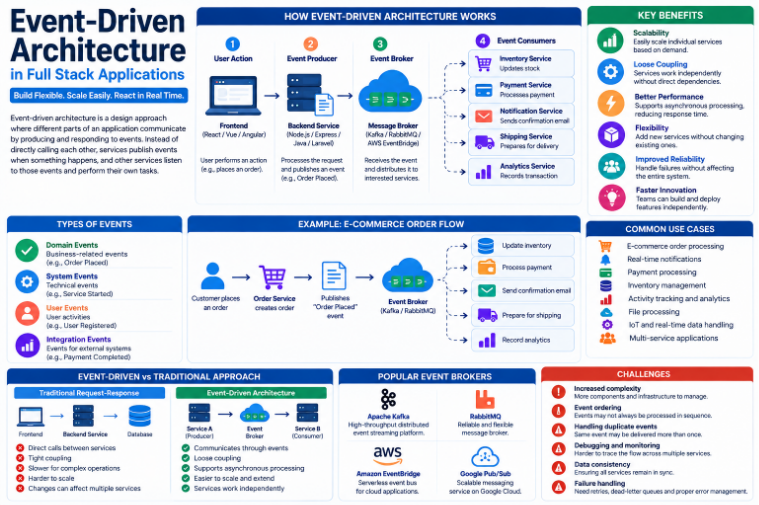
For example, when a customer places an order, the order service can publish an Order Created event. Other services can then respond to that event independently. The inventory service can reduce stock, the notification service can send an email, and the analytics service can record the transaction.
This approach allows each service to focus on its own responsibility without tightly depending on the other services.
How Event-Driven Architecture Works
A typical event-driven system contains three important elements: event producers, event consumers, and an event broker or message system.
The event producer is responsible for creating and publishing an event when something occurs. The event is then sent through a messaging system or event broker.
The event consumer receives the event and performs the required operation. Multiple consumers can respond to the same event without the producer needing to know how each consumer works.
A simplified flow can look like:
User Action → Frontend → Backend → Event → Event Broker → Multiple Services → Database / Notification / Analytics
This creates a flexible communication model between different parts of the application.
Event Producers
An event producer is the component that detects an important action and publishes an event.
For example, an e-commerce backend may create an event when an order is successfully placed. The event might contain information such as the order identifier, customer identifier, and order status.
The producer does not need to know which services will consume the event. Its primary responsibility is to communicate that the event has occurred.
This separation reduces dependencies between application components.
Event Consumers
Event consumers are services or components that listen for specific events and perform actions when those events occur.
For example, after receiving an Order Created event:
- The inventory service can update product stock.
- The payment service can process payment-related operations.
- The notification service can send an email.
- The analytics service can record the transaction.
- The shipping service can prepare the order for delivery.
Each consumer handles its own responsibility independently.
This makes the overall system more modular and easier to extend.
The Role of Event Brokers
An event broker or message broker acts as an intermediary between event producers and consumers.
Instead of sending events directly from one service to another, the producer publishes an event to the broker. Consumers can then receive events from the broker.
Popular technologies used for event-driven systems include Apache Kafka, RabbitMQ, Amazon Event Bridge, and other messaging platforms.
The broker helps manage communication between services and can provide features such as message delivery, queuing, event storage, and distribution.
Reducing Dependency Between Services
One of the major advantages of event-driven architecture is loose coupling.
In a tightly coupled application, one service may need to directly communicate with several other services. Changes in one service can therefore affect many other parts of the system.
With event-driven communication, services can interact through events instead. A producer does not need to know the internal implementation of its consumers.
This makes it easier to modify, replace, or add services without significantly changing existing application logic.
Improving Application Scalability
Event-driven architecture can help applications handle increasing workloads. Since event consumers can operate independently, additional instances of a service can be deployed when processing demand increases.
For example, if a notification service receives thousands of events, multiple instances can process those events simultaneously.
This makes event-driven architecture particularly useful for applications with unpredictable or high traffic volumes.
Supporting Asynchronous Processing
Not every operation needs to happen immediately before a user receives a response.
Some tasks, such as sending emails, generating reports, processing images, or updating analytics, can be performed in the background.
Event-driven architecture allows these tasks to be processed asynchronously. The user does not have to wait for every background operation to finish before receiving a response.
This can make applications feel faster and more responsive.
Real-World Applications
Event-driven architecture is useful in many types of applications.
Common examples include:
- E-commerce order processing.
- Online payment systems.
- Real-time notifications.
- Email processing.
- Inventory management.
- Delivery and shipping systems.
- Financial transaction processing.
- Activity tracking.
- Analytics platforms.
- IoT applications.
- Real-time dashboards.
These applications often contain multiple independent operations that can be triggered by the same event.
Example: E-Commerce Order Processing
Consider an online shopping application. When a customer places an order, several operations may need to happen.
In a traditional tightly coupled system, the order service might directly call the payment service, inventory service, notification service, and shipping service.
In an event-driven architecture, the order service can publish an Order Placed event.
The event can then be consumed by multiple services:
Order Service → Order Placed Event → Event Broker
The inventory service receives the event and updates stock.
The payment service processes the payment.
The notification service sends an order confirmation.
The shipping service prepares delivery information.
This structure allows each service to work independently and makes it easier to add new functionality later.
Improving System Flexibility
Another important benefit of event-driven architecture is flexibility. New consumers can be added without significantly modifying the existing event producer.
For example, an organization may initially use an order event for inventory and notifications. Later, it may want to add an analytics service that tracks customer purchasing behavior.
Instead of changing the order service extensively, the analytics service can simply subscribe to the existing event.
This makes the architecture easier to extend as business requirements change.
Challenges of Event-Driven Architecture
Although event-driven architecture provides many advantages, it also introduces additional complexity.
Some common challenges include:
- Understanding asynchronous communication.
- Managing event ordering.
- Handling duplicate events.
- Ensuring reliable event delivery.
- Debugging distributed workflows.
- Monitoring multiple services.
- Managing failed or delayed events.
- Maintaining consistent data across services.
Unlike a simple request-response application, developers may not be able to follow an entire operation through one function or API call.
Proper monitoring, logging, tracing, and error-handling strategies are therefore important.
Event Reliability and Failure Handling
Events may sometimes fail to reach their destination or a consumer may fail while processing an event.
Reliable event-driven systems need mechanisms for handling these situations. Depending on the technology being used, systems may support retries, acknowledgements, dead-letter queues, and persistent event storage.
These mechanisms help prevent important events from being permanently lost.
Developers must also consider what should happen if the same event is processed more than once. Designing consumers to handle duplicate events safely is an important part of reliable event-driven development.
Monitoring and Debugging
Debugging an event-driven application can be more complicated because a single event may trigger actions across multiple services.
Developers can improve visibility by implementing structured logging, centralized monitoring, and distributed tracing.
Tracking identifiers can also be associated with events so that developers can follow an operation across different services.
For example, an order identifier or correlation identifier can help developers trace the complete journey of an order from creation to payment, inventory processing, notification, and shipping.
Best Practices for Event-Driven Applications
Developers can improve the reliability and maintainability of event-driven applications by following established practices.
Some recommended practices include:
- Design clear and meaningful event names.
- Keep events focused on important business activities.
- Avoid putting unnecessary information into events.
- Make consumers capable of handling duplicate events safely.
- Implement retry mechanisms for temporary failures.
- Use dead-letter queues for events that repeatedly fail.
- Monitor event processing and consumer performance.
- Use correlation identifiers for debugging.
- Document event structures and responsibilities.
- Secure communication between services.
- Plan carefully for schema changes.
These practices help development teams build event-driven systems that are easier to understand and operate.
Event-Driven Architecture vs Traditional Request-Response
Traditional request-response architecture usually requires one component to send a request directly to another component and wait for a response.
Event-driven architecture focuses on notifying other components that something has happened.
Request-response communication is useful when an immediate response is required. Event-driven communication is particularly useful when multiple services need to react independently or when work can happen asynchronously.
Modern applications often use both approaches rather than choosing only one. Synchronous APIs can handle immediate operations while events can handle background and distributed processing.
Conclusion
Event-Driven Architecture provides a powerful approach for building modern full stack applications that need scalability, flexibility, and independent communication between services. Instead of tightly connecting every service through direct requests, applications can use events to communicate that important activities have occurred.
By using event producers, consumers, and event brokers, developers can create systems where multiple services respond independently to the same event. This architecture supports asynchronous processing, improves scalability, reduces service dependencies, and makes it easier to introduce new functionality.
However, event-driven architecture also introduces challenges such as event reliability, debugging, monitoring, duplicate processing, and data consistency. Developers must therefore combine event-driven principles with strong logging, monitoring, error handling, and security practices.
As modern applications continue to become more distributed and complex, event-driven architecture is becoming an increasingly valuable approach for building flexible and scalable software systems. Understanding how events move through a full stack application gives developers the knowledge required to design systems that can adapt to changing requirements while continuing to deliver reliable experiences to users.
