
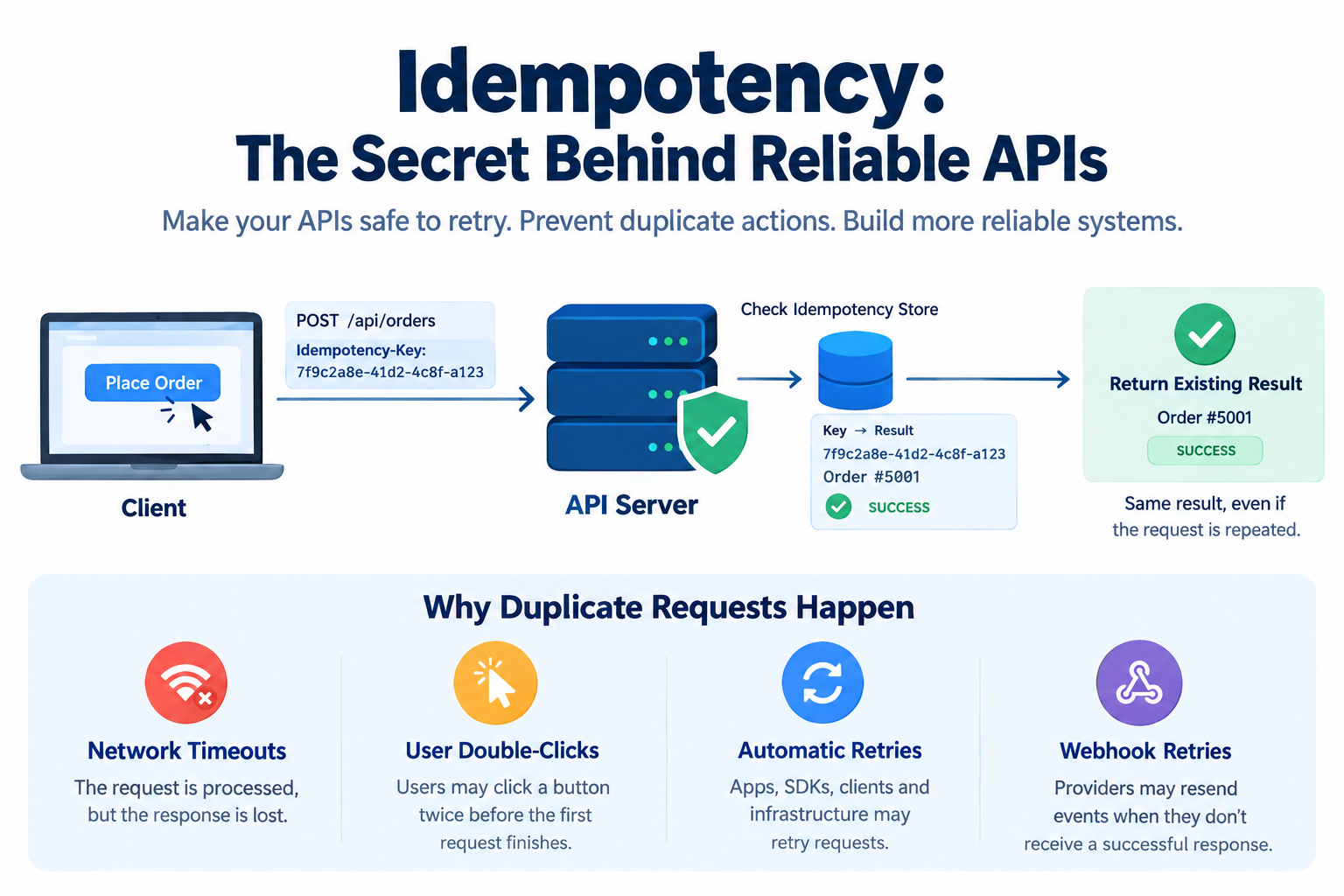
Modern applications rarely run in perfect conditions.
Networks fail.
Requests time out.
Servers restart.
Users click buttons twice.
Payment providers retry webhooks.
Mobile apps reconnect.
Because of these issues, the same API request can reach a server more than once.
So, what happens when the server processes the same request twice?
If the operation runs twice, the API may create duplicate data or trigger the same action again. In some cases, this can cause serious problems.
For example, a payment could be processed twice.
This is where idempotency becomes important.
What Is Idempotency?
Idempotency means that repeating an operation produces the same intended result as running it once.
Consider a payment API:
POST /api/payments
The client sends the request. The server processes the payment. However, the response never reaches the client because the network connection fails.
The client does not know whether the payment succeeded.
As a result, it sends the request again.
Without Idempotency
Request 1 → Payment Created
Request 2 → Another Payment Created
The customer could now be charged twice.
With Idempotency
Request 1 → Payment Created
Request 2 → Existing Result Returned
The server recognizes the repeated operation and returns the original result.
Therefore, the client can safely retry the request.
Why Do Duplicate Requests Happen?
Duplicate requests can happen for many reasons. They are not always caused by user mistakes.
In distributed systems, retries and connection failures are normal.
Network Timeouts
A server may finish processing a request. However, the response may not reach the client.
The flow can look like this:
Client → Server
          ↓
     Request processed
          ↓
       Response
          X
    Network timeout
The client may assume the request failed.
Therefore, it can send the request again.
User Double-Clicks
Users can also create duplicate requests.
For example, a customer may click Place Order twice before the first request finishes.
Click 1 → API
Click 2 → API
Both requests can reach the backend.
Without protection, the server could create two orders.
Automatic Retries
Applications often retry requests after temporary failures.
Mobile apps, SDKs, API clients, proxies, and infrastructure can all trigger retries.
As a result, backend systems must expect repeated requests.
Webhook Retries
External services can also resend webhook events.
For example:
payment.succeeded
payment.succeeded
payment.succeeded
A payment provider may resend the event when it does not receive a successful response.
Therefore, your system must process repeated webhook events safely.
A Real-World Example
Imagine an e-commerce application.
A customer clicks:
Place Order
The frontend sends:
POST /api/orders
The backend creates:
Order #5001
However, the response is lost because of a temporary network problem.
The frontend does not know that the order already exists.
So, it retries the request.
Without Idempotency
Order #5001 → Created
Order #5002 → Created
The customer may now have two orders for one purchase.
With Idempotency
First Request
     ↓
Create Order #5001
     ↓
Store Result

Retry Request
     ↓
Find Existing Operation
     ↓
Return Order #5001
Only one order is created.
This makes the API much safer during retries.
How Idempotency Keys Work
A common way to implement idempotency is with an idempotency key.
The client creates a unique key for one logical operation.
For example:
POST /api/orders
Idempotency-Key: 7f9c2a8e-41d2-4c8f-a123
The backend stores the key along with the operation result.
The relationship may look like this:
Idempotency Key
       ↓
7f9c2a8e-41d2-4c8f-a123
       ↓
Order #5001
       ↓
SUCCESS
When the same key arrives again, the backend checks the stored information.
If the operation already completed, the server can return the existing result.
Therefore, it does not create another order.
The Basic Flow
                Client
                   │
                   │ Request + Idempotency Key
                   ▼
             ┌─────────────┐
             │ API Server  │
             └──────┬──────┘
                    │
                    ▼
          Check Idempotency Store
                    │
          ┌─────────┴─────────┐
          │                   │
       New Key            Existing Key
          │                   │
          ▼                   ▼
   Process Request       Return Stored Result
          │
          ▼
   Save Operation Result
          │
          ▼
       Response
This pattern helps APIs handle retries more reliably.
Where Should Idempotency Data Be Stored?
The best storage option depends on the system.
Common choices include:
- Redis
- Relational databases
- Distributed key-value stores
Each option has different performance and consistency characteristics.
For high-throughput systems, Redis can provide fast key-based access. It also supports expiration mechanisms.
However, database-backed storage can be useful when idempotency data must stay closely connected to the business transaction.
For this reason, the storage choice should match the application’s architecture.
Idempotency Is More Than Checking a Key
Simply checking whether a key exists is not enough.
Two identical requests can arrive at almost the same time.
Consider this example:
Request A ──────┐
               ├──→ Check Key → Not Found
Request B ──────┘
               └──→ Check Key → Not Found
Both requests may see the key as new.
As a result, both requests could create the resource.
This situation is called a race condition.
How Can You Prevent the Race?
The solution depends on the system architecture.
Possible approaches include:
- Atomic database operations
- Unique database constraints
- Distributed locks
- Concurrency-safe storage operations
The key point is simple.
Idempotency is a distributed systems problem, not just a request-header feature.
What Happens When a Key Is Reused?
A robust API should also validate the request when a client reuses an idempotency key.
Suppose the first request contains:
{
  "amount": 1000,
  "currency": "INR"
}
The request uses:
Idempotency-Key: ABC123
Later, the client sends:
{
  "amount": 5000,
  "currency": "INR"
}
It uses the same key.
The server should not treat these requests as the same operation.
Instead, it can compare the request details.
If the parameters differ, the server can reject the second request.
Therefore, one idempotency key should represent one logical operation.
It should not represent an unlimited number of unrelated requests.
Idempotency and HTTP Methods
HTTP semantics already define some methods as idempotent.
These include:
- GET
- PUT
- DELETE
However, an idempotent HTTP method does not mean that every implementation is automatically free from side effects.
POST is different.
POST is commonly used to create resources or trigger actions. It is not inherently idempotent.
Therefore, explicit idempotency mechanisms are especially useful for operations such as:
- Payments
- Order creation
- Resource provisioning
- Subscription creation
- Booking systems
- Financial transactions
Idempotency vs. Deduplication
Idempotency and deduplication are related. However, they solve different problems.
What Is Deduplication?
Deduplication identifies duplicate events or messages.
For example:
Webhook arrives twice
        ↓
Identify the same event
        ↓
Process once
The system detects that both events represent the same message.
What Is Idempotency?
Idempotency makes an operation safe when the same request runs more than once.
The difference becomes important in distributed systems.
A system can use deduplication to identify repeated events. It can also use idempotency to prevent repeated business effects.
In practice, both techniques can work together.
Best Practices for Idempotent APIs
A reliable implementation should follow a few basic rules.
Use Unique Keys
Generate a unique idempotency key for each logical operation.
Do not reuse the same key for unrelated requests.
Store the Result
Keep enough information to recognize a completed operation.
Depending on the system, this may include:
- Idempotency key
- Request status
- Response data
- Resource ID
- Request fingerprint
- Creation timestamp
Make the Check Atomic
Do not rely on a simple:
Check → Process → Save
sequence when multiple requests can arrive at the same time.
Use a concurrency-safe mechanism instead.
Validate Reused Keys
If the same key arrives with different request parameters, reject the request or handle it according to your API contract.
This prevents accidental key reuse.
Set an Appropriate Retention Period
Idempotency records do not always need to remain forever.
A system can remove old records after an appropriate period.
However, the retention period should match the business risk and expected retry window.
Test Failure Scenarios
Do not test only successful requests.
Also test:
- Network timeouts
- Client retries
- Duplicate clicks
- Webhook retries
- Server restarts
- Concurrent requests
- Partial failures
These scenarios reveal whether the API is truly resilient.
Why Idempotency Matters
Idempotency improves API reliability because it makes retries safer.
Modern systems depend heavily on retries. Network failures, temporary outages, and service interruptions can happen at any time.
Without idempotency, those retries can create duplicate operations.
With a well-designed idempotency strategy, the server can recognize repeated requests and preserve the intended business result.
This is especially important for payments, orders, bookings, subscriptions, and other operations where duplicate actions can have real consequences.
Conclusion
Reliable APIs must expect failure.
Requests can time out. Users can click twice. Services can retry webhooks. Networks can disconnect.
Therefore, API designers need to consider what happens when the same request arrives more than once.
Idempotency provides a practical way to handle these situations safely.
Idempotency keys, atomic operations, request validation, and appropriate data storage can prevent duplicate business actions.
The most important question is simple:
If this request runs twice, will my system still produce the correct result?
If the answer is yes, your API is better prepared for the realities of distributed systems.
