
Modern applications often run inside containers, which package the application together with everything it needs to work. When an application grows, managing many containers across different servers can become difficult. This is where Kubernetes helps.
What is Kubernetes?
Kubernetes, also known as K8s, is an open-source platform used to manage containerised applications. It helps developers deploy, run, scale, and maintain applications automatically.
For example, imagine an online shopping application running in several containers. If the number of users suddenly increases, Kubernetes can start additional containers to handle the extra traffic. When traffic decreases, it can reduce them again.
How Does Kubernetes Work?
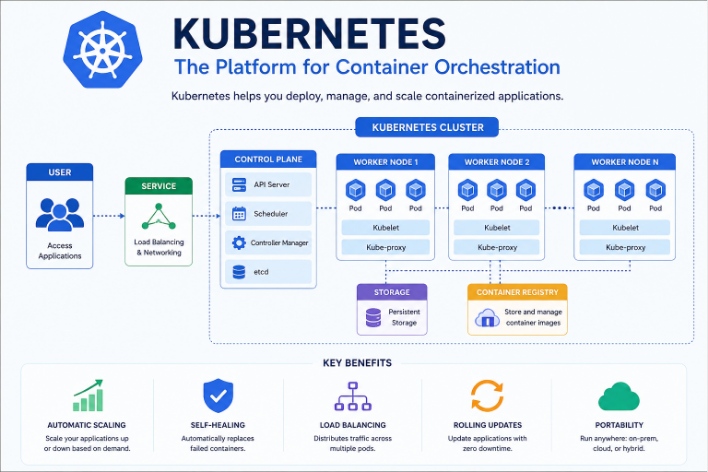
Kubernetes organises applications using a few basic components.
A Cluster is the complete Kubernetes environment containing the machines that run applications.
A Node is a machine inside the cluster. It can be a physical server or a virtual machine.
A Pod is the smallest unit in Kubernetes. A pod usually contains one application container and provides the environment needed to run it.
A Deployment tells Kubernetes how an application should run, including how many copies of the application are required.
A Service provides a stable way for users or other applications to access the running pods.
Why Use Kubernetes?
One major benefit of Kubernetes is automatic scaling. It can increase or decrease application resources depending on demand.
Kubernetes also provides self-healing. If a container crashes or stops working, Kubernetes can automatically replace it with a new one.
It also supports load balancing, which distributes incoming traffic across multiple application instances to prevent one instance from becoming overloaded.
Another advantage is portability. Kubernetes can run in local data centres as well as cloud environments, making it easier to deploy applications across different infrastructure.
Kubernetes and Docker
Docker is commonly used to create and run containers, while Kubernetes is used to manage containers at scale.
A simple way to understand the difference is:
Docker → Creates and runs containers
Kubernetes → Organises, scales, and manages containers
They solve different problems and are often used as part of the same container-based development workflow.
Conclusion
Kubernetes makes managing containerised applications easier, especially when applications become large and need to run across multiple servers. Features such as automatic scaling, self-healing, load balancing, and deployment management help teams build applications that are more reliable and easier to maintain.
For developers learning modern application deployment and DevOps, Kubernetes is an important technology to understand.
