
Introduction
As web applications become more complex, they often serve users with different responsibilities and levels of access. For example, an e-commerce platform may have customers, sellers, and administrators, while a company management system may include employees, managers, HR personnel, and administrators. Since each user performs different tasks, they should only be able to access the features and information relevant to their role.
Role-Based Access Control (RBAC) is a widely used authorization model that addresses this need by restricting access based on predefined roles. Instead of assigning permissions to every individual user, permissions are associated with roles, and users inherit those permissions by being assigned a role. This approach simplifies access management, enhances security, and improves the maintainability of applications.
What is Role-Based Access Control (RBAC)?
Role-Based Access Control is an authorization mechanism that determines what actions a user is allowed to perform based on the role assigned to them. A role represents a collection of permissions that define the responsibilities of a particular group of users.
For instance, an administrator may have permission to manage users and system settings, while a manager can review team performance, and an employee can only access their own profile and personal information. By organizing permissions around roles rather than individuals, organizations can manage user access more efficiently.
RBAC differs from authentication. Authentication verifies a user’s identity, while authorization determines what that authenticated user is permitted to do. RBAC specifically focuses on authorization.
Why RBAC is Important
Security is one of the primary reasons organizations implement RBAC. It prevents unauthorized users from accessing confidential information or performing actions beyond their responsibilities. This significantly reduces the risk of accidental or intentional misuse of sensitive data.
RBAC also improves system administration by making permission management easier. When an employee changes departments or responsibilities, administrators only need to assign a different role instead of modifying multiple individual permissions. This reduces administrative effort and minimizes the likelihood of configuration errors.
As applications grow and user bases expand, RBAC provides a scalable solution for managing access control. New roles and permissions can be introduced without requiring major changes to the application’s overall structure.
Core Components of RBAC
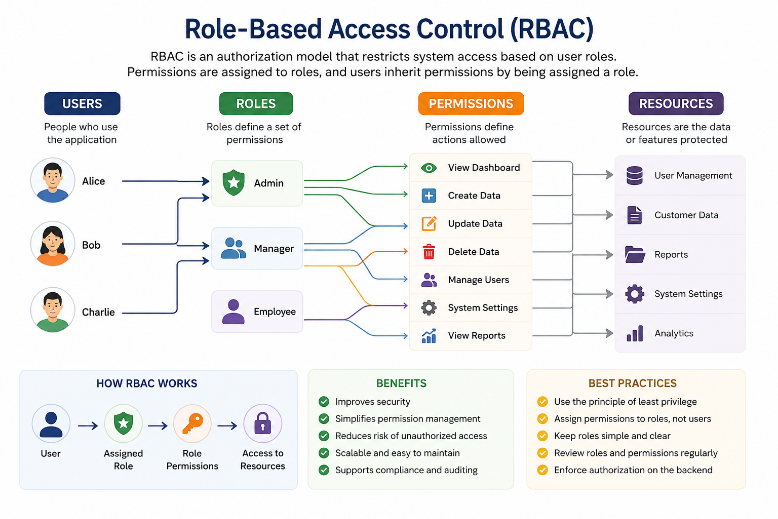
RBAC consists of four essential components: users, roles, permissions, and resources.
Users are individuals who interact with the application. Roles define a user’s responsibilities within the system. Permissions specify the actions that can be performed, such as viewing, creating, updating, or deleting information. Resources refer to the application features or data that are protected by these permissions.
The relationship between these components forms the foundation of RBAC. Users receive one or more roles, and each role contains a predefined set of permissions that determine access to application resources.
Benefits of RBAC
One of the greatest advantages of RBAC is enhanced security. Since users only receive permissions necessary for their responsibilities, the risk of unauthorized access is greatly reduced.
RBAC also improves operational efficiency. Administrators can manage permissions through roles instead of configuring access individually for every user. This approach becomes especially valuable in large organizations with hundreds or thousands of users.
Another significant benefit is consistency. Users with identical responsibilities receive identical permissions, ensuring uniform access across the organization. This consistency simplifies compliance with organizational policies and regulatory requirements.
Furthermore, RBAC makes applications easier to maintain. As business requirements evolve, modifying a role automatically updates permissions for every user assigned to that role, eliminating repetitive administrative work.
Challenges of RBAC
Although RBAC offers many advantages, implementing it effectively requires careful planning. Defining roles that accurately represent business responsibilities can be challenging, particularly in organizations with complex workflows.
Another challenge is role management. Creating too many specialized roles can make the system difficult to maintain, while creating too few may result in users receiving unnecessary permissions. Maintaining the right balance is essential for an effective RBAC strategy.
Organizations must also periodically review assigned roles to ensure users retain only the permissions required for their current responsibilities.
RBAC in Full-Stack Applications
In a full-stack application, RBAC should be enforced across both the frontend and the backend.
The frontend enhances user experience by displaying only the features that users are authorized to access. This creates a cleaner interface and reduces confusion. However, frontend restrictions should never be considered sufficient for security because they can be bypassed.
The backend serves as the ultimate authority for authorization. Every request should be validated to ensure the user has the appropriate permissions before sensitive data is returned or critical operations are performed. This layered approach provides strong protection against unauthorized access.
Best Practices
Successful RBAC implementations follow several best practices. Permissions should always be assigned to roles rather than directly to users whenever possible. Organizations should adopt the principle of least privilege, granting users only the minimum permissions required to perform their work.
Authorization logic should remain centralized and consistent throughout the application to avoid conflicting access rules. Regular audits of user roles and permissions help maintain security as organizational structures evolve.
Clear documentation of roles and their associated permissions also improves system maintainability and simplifies onboarding for both developers and administrators.
Conclusion
Role-Based Access Control is a fundamental security model for modern full-stack applications. By organizing permissions around roles instead of individual users, RBAC simplifies access management, strengthens application security, and supports long-term scalability.
Whether building a small business application or a large enterprise system, implementing a well-designed RBAC strategy ensures that users have access only to the resources they need while protecting sensitive information from unauthorized access. As applications continue to grow in complexity, RBAC remains one of the most effective and widely adopted approaches to authorization.
