
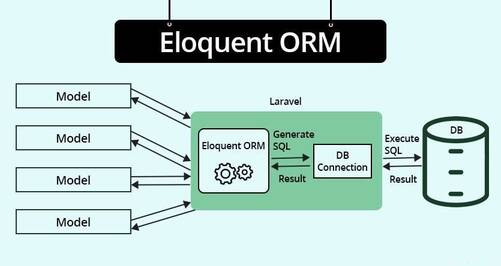
Laravel’s Eloquent ORM (Object Relational Mapping) is one of the most powerful and developer-friendly features of the framework.
It allows you to interact with your database using simple PHP objects, instead of writing complex SQL queries.
This deep dive will help you fully understand how Eloquent works and how to use it effectively in real projects.
1. What is Eloquent ORM?
Eloquent is Laravel’s built-in ORM that provides:
- Object-based database interaction
- Cleaner and readable code
- Automatic SQL query handling
- Relationship mapping
- Built-in CRUD operations
Each database table = one Model
Example: products table → Product model
Eloquent follows Active Record Pattern, meaning each model object directly manages:
- Inserting
- Updating
- Deleting
- Querying
2. Creating a Model
php artisan make:model Product
This creates:
app/Models/Product.php
A basic model looks like:
class Product extends Model
{
protected $fillable = [‘name’, ‘price’, ‘description’];
}
$fillable
Prevents mass assignment vulnerability.
3. Basic CRUD Operations
Create Data
Product::create([
‘name’ => ‘Laptop’,
‘price’ => 50000,
‘description’ => ‘High performance laptop’
]);
Read Data
$products = Product::all(); // Returns all records
$product = Product::find(1); // Fetch by ID
$product = Product::where(‘price’, ‘>’, 10000)->get();
Update Data
$product = Product::find(1);
$product->update([‘price’ => 55000]);
Delete Data
$product = Product::find(1);
$product->delete();
4. Eloquent Query Builder (Advanced Queries)
Eloquent supports beautiful, chainable queries:
$expensive = Product::where(‘price’, ‘>’, 20000)
->orderBy(‘price’, ‘desc’)
->take(5)
->get();
Common methods:
- where()
- orWhere()
- orderBy()
- limit()
- paginate()
Example: Pagination
$products = Product::paginate(10);
5. Eloquent Relationships (Very Important)
Databases have relations — Eloquent makes them easy.
5.1 One-to-One
Example: User ↔ Profile
User.php
public function profile()
{
return $this->hasOne(Profile::class);
}
5.2 One-to-Many
Example: Category → many Products
Category.php
public function products()
{
return $this->hasMany(Product::class);
}
Product.php
public function category()
{
return $this->belongsTo(Category::class);
}
5.3 Many-to-Many
Example: Students ↔ Courses
Student.php
public function courses()
{
return $this->belongsToMany(Course::class);
}
Laravel automatically manages pivot table: course_student.
5.4 Polymorphic Relationships
Example: Comments on Posts or Videos
Comment.php
public function commentable()
{
return $this->morphTo();
}
6. Eager Loading vs Lazy Loading
Lazy Loading (default → multiple queries run)
$users = User::all();
foreach ($users as $user) {
echo $user->posts; // triggers new query each time
}
Eager Loading (best performance)
$users = User::with(‘posts’)->get();
🔥 Reduces N+1 query problem → much faster.
7. Mutators & Accessors
Modify data before saving or after retrieving.
Accessor (get value)
public function getNameAttribute($value)
{
return ucfirst($value);
}
Mutator (set value)
public function setNameAttribute($value)
{
$this->attributes[‘name’] = strtolower($value);
}
8. Soft Deletes
Allows “invisible” deletion without removing data from DB.
Enable
use SoftDeletes;
Migration:
$table->softDeletes();
9. Timestamps Handling
Laravel auto-manages:
- created_at
- updated_at
Disable timestamps:
public $timestamps = false;
10. Eloquent API Resources (For APIs)
Clean API responses:
php artisan make:resource ProductResource
Example:
return new ProductResource($product);
Improves formatting and structure of JSON responses.
