
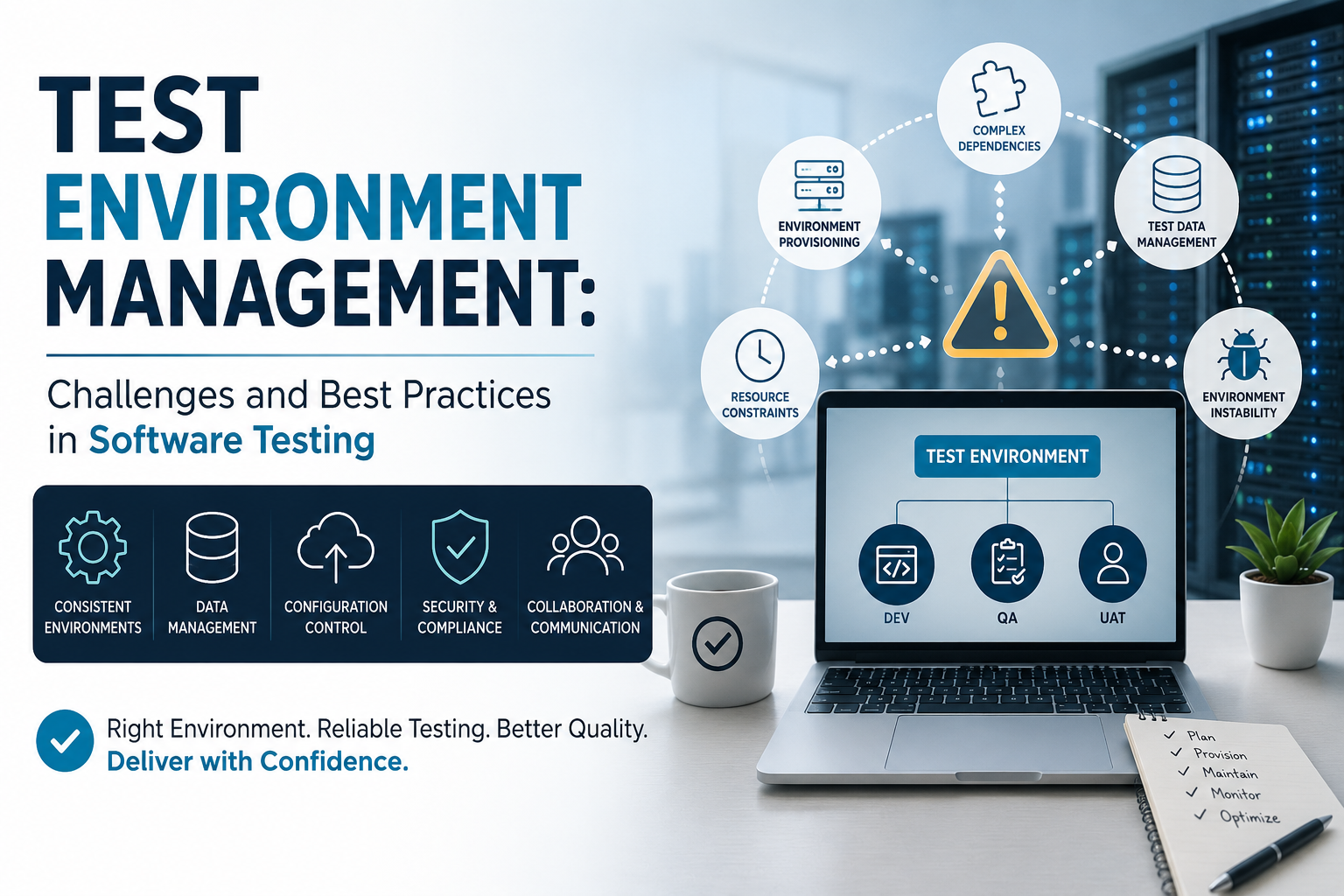
In software testing, the quality of test results depends heavily on the quality of the test environment. Even the most skilled QA engineers and the most comprehensive test cases can produce misleading outcomes if they are executed in unstable, inconsistent, or poorly managed environments.
As applications become more complex, involving multiple integrations, cloud services, mobile platforms, APIs, and microservices, Test Environment Management (TEM) has evolved into a critical discipline. Effective environment management helps teams achieve faster releases, higher quality, and greater confidence in their testing efforts.
What is Test Environment Management?
Test Environment Management is the process of planning, provisioning, configuring, maintaining, monitoring, and retiring environments used for software testing.
A test environment typically includes:
- Application servers
- Databases
- APIs and integrations
- Network configurations
- Test data
- Third-party services
- Hardware and virtual machines
- Monitoring and logging tools
The primary goal is to ensure that testers have a stable and reliable environment that accurately represents production conditions.
Why Test Environment Management Matters
Poor environment management often becomes one of the biggest bottlenecks in software delivery.
A well-managed test environment provides:
Higher Testing Accuracy
Applications behave differently depending on configurations and dependencies. Consistent environments reduce false positives and false negatives.
Faster Release Cycles
Teams spend less time troubleshooting environment issues and more time executing tests.
Better Collaboration
Developers, testers, DevOps engineers, and business stakeholders work from a shared understanding of environment availability and readiness.
Reduced Costs
Proper utilization of resources prevents unnecessary infrastructure expenses.
Improved User Experience
Production-like testing uncovers defects before they impact customers.
Common Challenges in Test Environment Management
1. Environment Availability Issues
One of the most common challenges is limited environment availability.
Multiple teams often compete for the same testing environments, resulting in:
- Scheduling conflicts
- Testing delays
- Resource bottlenecks
- Longer release timelines
For example, an integration testing team may require the same environment being used by the regression testing team, creating dependency conflicts.
Impact
- Missed deadlines
- Delayed test execution
- Reduced productivity
2. Environment Configuration Drift
Configuration drift occurs when environments gradually become different from each other over time.
Examples include:
- Different software versions
- Missing patches
- Incorrect server settings
- Inconsistent database configurations
Even small differences can produce inconsistent results between environments.
Impact
- Difficult defect reproduction
- Increased debugging effort
- Reduced confidence in testing results
3. Test Data Management Problems
Testing is only as effective as the data used.
Challenges include:
- Insufficient test data
- Outdated datasets
- Sensitive customer information
- Data refresh delays
- Regulatory compliance concerns
Realistic test data is essential for validating application behavior under actual business scenarios.
Impact
- Incomplete test coverage
- Security risks
- Inaccurate testing outcomes
4. Complex System Dependencies
Modern applications rarely operate independently.
They often depend on:
- Third-party APIs
- Payment gateways
- Authentication providers
- Messaging systems
- Cloud services
When any dependency becomes unavailable, testing can be significantly affected.
Impact
- Blocked test execution
- Increased environment instability
- Delayed project delivery
5. Lack of Environment Visibility
Many organizations struggle to track:
- Environment health
- Current usage
- Scheduled maintenance
- Available resources
Without visibility, teams waste valuable time identifying issues and coordinating environment access.
Impact
- Poor planning
- Communication gaps
- Lower testing efficiency
6. Infrastructure Costs
Maintaining multiple environments can be expensive.
Organizations often maintain:
- Development
- QA
- Integration
- UAT
- Performance
- Staging environments
Without proper governance, infrastructure utilization can become inefficient.
Impact
- Increased operational costs
- Resource wastage
- Budget constraints
Best Practices for Effective Test Environment Management
1. Plan Environments Early
Environment planning should begin during project initiation rather than before testing starts.
Define:
- Environment requirements
- Infrastructure needs
- Data requirements
- Access controls
- Integration dependencies
Early planning reduces last-minute surprises.
Recommendation
Include environment readiness as a deliverable within project planning activities.
2. Standardize Environment Configurations
Standardization minimizes inconsistencies and improves reliability.
Key areas for standardization:
- Operating systems
- Application configurations
- Middleware versions
- Database settings
- Security policies
Benefits
- Easier maintenance
- Faster troubleshooting
- Improved consistency
Configuration management tools can help enforce standards across environments.
3. Adopt Infrastructure as Code (IaC)
Infrastructure as Code enables teams to create environments through automated scripts rather than manual setup.
Popular IaC tools include:
- Terraform
- Ansible
- AWS CloudFormation
- Azure Resource Manager
Benefits
- Consistent environment creation
- Faster provisioning
- Reduced human errors
- Improved scalability
Infrastructure becomes repeatable and predictable.
4. Implement Strong Test Data Management
A structured Test Data Management (TDM) strategy is essential.
Best practices include:
- Data masking
- Synthetic data generation
- Automated data refresh
- Data version control
- Secure access management
Benefits
- Better test coverage
- Regulatory compliance
- Improved testing accuracy
The right data often determines the success of testing initiatives.
5. Leverage Virtualization and Containerization
Virtual environments and containers improve flexibility and utilization.
Technologies include:
- Docker
- Kubernetes
- Virtual Machines
- Cloud-based testing environments
Benefits
- Rapid environment provisioning
- Isolation of workloads
- Reduced infrastructure costs
- Better scalability
Containerized environments also support consistent testing across teams.
6. Monitor Environment Health Continuously
Continuous monitoring helps identify issues before they impact testing.
Key metrics include:
- Server availability
- CPU utilization
- Memory usage
- Network performance
- API response times
- Database health
Monitoring Tools
- Azure Monitor
- Grafana
- Prometheus
- Splunk
- Datadog
Benefits
- Faster issue resolution
- Reduced downtime
- Improved stability
7. Establish Environment Governance
A governance framework helps manage environment usage effectively.
Define:
- Ownership responsibilities
- Access controls
- Usage policies
- Change management processes
- Maintenance schedules
Benefits
- Increased accountability
- Better resource management
- Reduced conflicts
Every environment should have clearly defined stakeholders.
8. Automate Environment Provisioning
Manual setup processes are slow and error-prone.
Automation enables:
- On-demand environments
- Consistent configurations
- Faster deployments
- Reduced operational effort
Benefits
- Improved productivity
- Faster testing cycles
- Reduced setup errors
Automation is particularly valuable for Agile and DevOps teams.
9. Maintain Environment Documentation
Documentation is often overlooked but remains critical.
Document:
- Environment architecture
- Configuration settings
- Dependencies
- Access procedures
- Maintenance activities
Benefits
- Faster onboarding
- Easier troubleshooting
- Improved collaboration
Well-maintained documentation reduces knowledge silos.
10. Integrate Environment Management into DevOps
Modern software delivery requires close collaboration between QA, Development, and Operations teams.
Integrating environment management into DevOps enables:
- Continuous testing
- Continuous deployment
- Faster feedback loops
- Improved release quality
Key Practices
- Automated deployments
- Configuration versioning
- Infrastructure automation
- Continuous monitoring
This approach ensures testing environments evolve alongside application changes.
Conclusion
Test Environment Management is no longer just an operational activity. It is a strategic function that directly influences software quality, delivery speed, and testing effectiveness.
Organizations that invest in standardized environments, automation, monitoring, test data management, and governance gain a significant advantage in today’s fast-paced development landscape.
As software systems continue to grow in complexity, the ability to provide stable, scalable, and production-like environments will remain a key differentiator for successful QA teams. By adopting proven best practices and proactively addressing common challenges, testing teams can improve efficiency, reduce risks, and deliver high-quality software with greater confidence.
